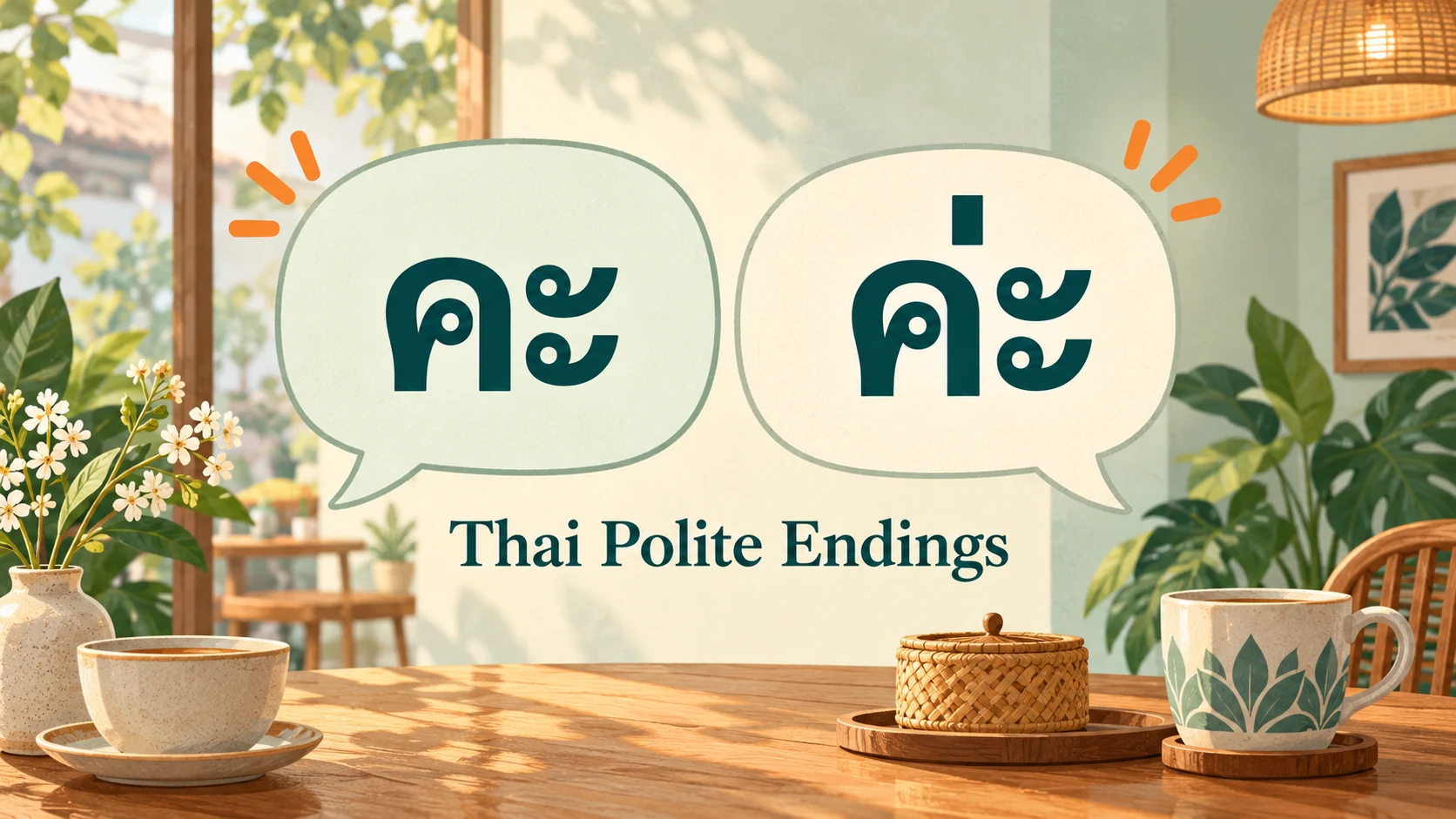

You have learned to add a polite ending to a Thai sentence. Then you notice two spellings that often appear as the same English word, “kha”: คะ (khá) and ค่ะ (khâ). Which one belongs after a question, and which one belongs after “thank you”?
The useful starting point is to learn their sound and their job together. These endings do not change the main information in your sentence, but they help shape how you speak to another person.
The quick answer
คะ — khá: a high-tone ending commonly used in polite questions.
ค่ะ — khâ: a falling-tone ending commonly used in polite statements and acknowledgements.
They are conventionally associated with feminine polite speech. Choose the speaking style that suits you; the listener’s gender does not decide which ending you use.
1. Hear the difference before memorising the spelling
Both endings have a short vowel. In our reading system, kh represents an aspirated k sound: say k with a small puff of air. It is not an English k followed by a separate h syllable.
| Thai | PronunciationThai Simple IPA | Listen for |
|---|---|---|
| คะ | khá | A short vowel with a high tone |
| ค่ะ | khâ | A short vowel with a falling tone |
| นะ | ná | A softening particle; learn it as part of a complete expression |
Pronunciation (Thai Simple IPA). Thai Simple IPA here means an IPA-based learner transcription following the Thai Notes pronunciation guide, rather than strict IPA. An acute mark indicates high tone and a circumflex indicates falling tone. Predictable glottal stops are not written in this learner system. Every complete example below has three lines: Thai, pronunciation, and English. Long vowels are doubled; tone marks appear on the first vowel: low à, falling â, high á, rising ǎ; mid tone is unmarked. Hyphens separate syllables within longer words as a display aid; spaces separate words.
You may hear variation in the pitch of natural speech, including a low-tone variant (khà) of the usual falling-tone ending (khâ), recorded in dictionaries. For this first contrast, practise the high versus falling forms clearly, then listen for how a speaker uses them in context. Do not lengthen the vowel just because an English spelling repeats the letter a.
2. Match the ending to the complete sentence
For a straightforward polite question in this speaking style, start with คะ (khá). For a straightforward statement or a polite acknowledgement, start with ค่ะ (khâ). Learn the question or statement itself as a useful chunk instead of attaching an ending to isolated English words.
- ราคาเท่าไหร่คะ
raa-khaa thâo-rài khá
How much is it? - ขอบคุณค่ะ
khɔ̀ɔp-khun khâ
Thank you. - ค่ะ
khâ
A polite acknowledgement, such as “yes” or “okay”, when the context supports that meaning.
If you are using the masculine polite speaking style, you will commonly hear ครับ (khráp) in both questions and statements. You do not need to switch to feminine endings because you are speaking to a woman.
3. Notice the important softening expression
The question-versus-statement shortcut is a starting point, not a rule for every expression. In นะคะ (ná khá), the spelling is คะ (khá), even when the sentence is not a question. The preceding นะ (ná) helps soften the expression.
ขอบคุณนะคะ
khɔ̀ɔp-khun ná khá
Thank you, with a warmer or softer tone in a suitable context.
Use this familiar combination.
4. Practise a small exchange
Imagine a customer asking about a price. Both speakers in this example use feminine polite endings. Read each line for its meaning first, then pay attention to its final particle.

ราคาเท่าไหร่คะ
raa-khaa thâo-rài khá
How much is it?
ห้าสิบบาทค่ะ
hâa sìp bàat khâ
Fifty baht.
Customer
ราคาเท่าไหร่คะ
raa-khaa thâo-rài khá
How much is it?
Seller
ห้าสิบบาทค่ะ
hâa sìp bàat khâ
Fifty baht.
Customer
ขอบคุณค่ะ
khɔ̀ɔp-khun khâ
Thank you.
For another short practice, say the question, pause, and imagine the reply before continuing. Then swap roles. If you need a number refresher, review Thai numbers 1–10. Keep the pace comfortable; an ending is easier to practise when the rest of the sentence is familiar.
Read aloud: 15 useful practice sentences
Read the Thai first, check the pronunciation, then say the line again without looking at the reading aid. These examples use feminine polite speech. Practise the questions with their replies, then swap roles.
Practice audio is AI-generated using the Mali voice from ElevenLabs. Listen, pause, and repeat each sentence aloud.
- สวัสดีค่ะ
sà-wàt-dii khâ
Hello. - สบายดีไหมคะ
sà-baai dii mǎi khá
How are you? - สบายดีค่ะ
sà-baai dii khâ
I’m well. - ราคาเท่าไหร่คะ
raa-khaa thâo-rài khá
How much is it? - ห้าสิบบาทค่ะ
hâa sìp bàat khâ
Fifty baht. - มีไหมคะ
mii mǎi khá
Do you have it? (Ask about an item already identified.) - มีค่ะ
mii khâ
Yes, we have it. - ไม่มีค่ะ
mâi mii khâ
No, we don’t have it. - เอาไหมคะ
ao mǎi khá
Would you like it? (Offer an item.) - เอาค่ะ
ao khâ
Yes, I’d like it. - ไม่เอาค่ะ
mâi ao khâ
No, I don’t want it. - ขอบคุณค่ะ
khɔ̀ɔp-khun khâ
Thank you. - ขอโทษค่ะ
khɔ̌ɔ-thôot khâ
Sorry. / Excuse me. - ขอบคุณนะคะ
khɔ̀ɔp-khun ná khá
Thank you. (A softer or warmer expression.) - รอสักครู่นะคะ
rɔɔ sàk-khrûu ná khá
Please wait a moment.
For ไหม (mǎi), this reading practice uses the rising-tone form; you may also hear mái in natural questions. The short refusal above can sound direct: adding a thank-you can make it more considerate in a suitable situation. Read the final particles clearly, without stretching their short vowels.
Your turn: choose the ending
- You ask a shopkeeper a price: ราคาเท่าไหร่___
raa-khaa thâo-rài ___
How much is it? - You thank someone using a straightforward polite expression: ขอบคุณ___
khɔ̀ɔp-khun ___
Thank you. - You choose the softer expression with นะ (ná): ขอบคุณนะ___
khɔ̀ɔp-khun ná ___
Thank you (softer).
Check the answers
- ราคาเท่าไหร่คะ
raa-khaa thâo-rài khá
How much is it? — use คะ (khá) for this question. - ขอบคุณค่ะ
khɔ̀ɔp-khun khâ
Thank you. — use ค่ะ (khâ) for this straightforward polite thank-you. - ขอบคุณนะคะ
khɔ̀ɔp-khun ná khá
Thank you. (A softer or warmer expression.) — learn นะคะ (ná khá) together; it is not นะค่ะ.
Takeaway: begin with คะ (khá) for questions and ค่ะ (khâ) for statements and acknowledgements, then learn common combinations such as นะคะ (ná khá) as complete expressions. Your wording, voice and situation work together; one particle cannot make every sentence appropriate in every context.
For more everyday language to practise, explore five useful Thai phrases for beginners.
Put a little Thai into practice
Try Ton’s free beginner mini course: introduce yourself, order a drink, and ask someone to repeat. It includes three video lessons and worksheets, delivered one lesson per day after you confirm your email.
Start my free Thai course →Pronunciation and usage references
The explanations and exercises above are original. Reference entries: คะ, ค่ะ, and นะ. Additional pronunciation checks: price-question word, thank-you expression, excuse-me expression, question particle, brief-wait expression, and a moment. Reading-system reference: Thai Notes pronunciation guide. Full-IPA cross-check: Wikipedia’s Thai IPA key.
Learn with personal guidance
Book a private lesson
Practise real conversations and build clearer pronunciation with lessons tailored to your goals.
Professional Teacher on italki
- 1-on-1 lessons
- Personalised learning
- Pronunciation feedback
Check availability and book securely through your preferred platform.